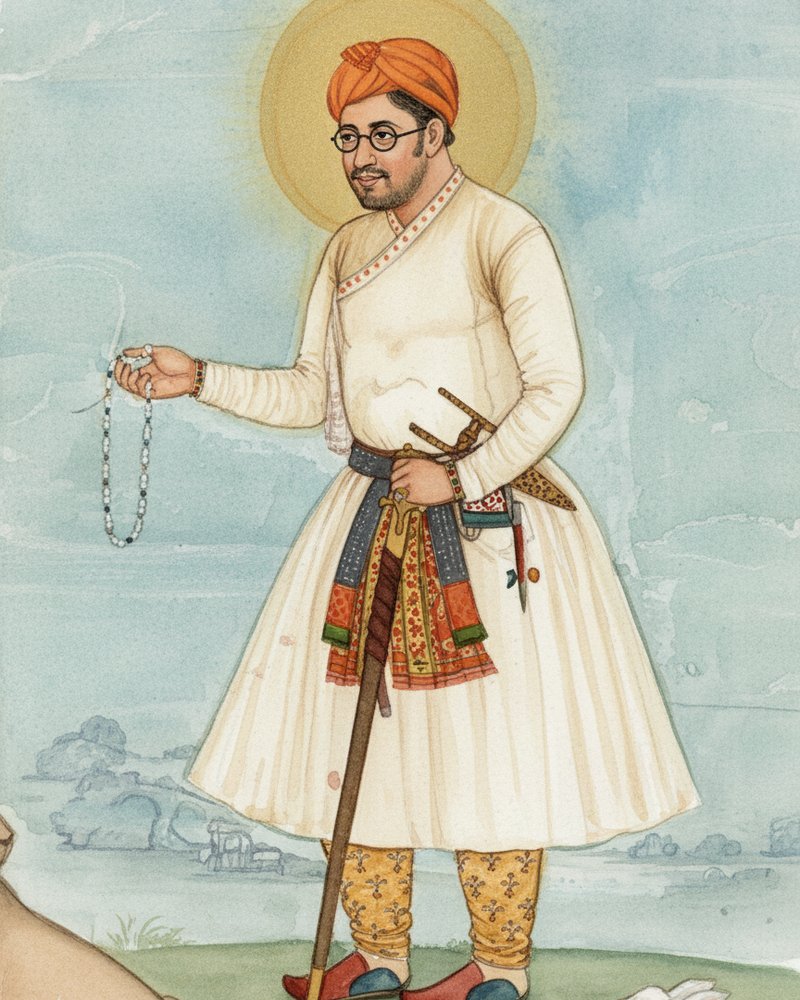
Original illustration for Bharat Legends.
Akbar the Great
- ◆Reigned 1556–1605
- ◆Abolished the jizya tax
- ◆Founded Fatehpur Sikri
- ◆Court of the Navratnas including Birbal and Tansen
The Story
Akbar became emperor when he was only thirteen years old, and he grew up to become one of the most curious rulers India has ever seen. He could not read very well, but he loved listening to stories, songs and ideas.
In his palace at Fatehpur Sikri he built a special hall where Hindus, Muslims, Christians, Jains and Sikhs could all come and talk together about what they believed. Akbar also removed unfair taxes on non-Muslims, married a Rajput princess, and gathered nine brilliant people at his court called the Navratnas — including the funny minister Birbal and the great singer Tansen.
Jalaluddin Muhammad Akbar ruled the Mughal Empire from 1556 to 1605. He inherited a shaky kingdom at thirteen and slowly turned it into a strong, well-run state that reached from Kabul to Bengal and down into the Deccan.
He built alliances with Rajput kingdoms through marriage and respect rather than only through war.
Akbar believed in an idea called sulh-i-kul, or 'peace with all'. He removed the jizya tax on non-Muslims, invited scholars of many religions to his Ibadat Khana (House of Worship), and encouraged translations of Hindu classics into Persian.
His minister Todar Mal set up a fair land-revenue system that lasted for centuries. His court chronicler Abul Fazl wrote the huge book Akbarnama about his life, and the red-stone city of Fatehpur Sikri still stands as a witness to his open, curious mind.
Learn More
These links go to other websites — ask a grown-up before tapping.