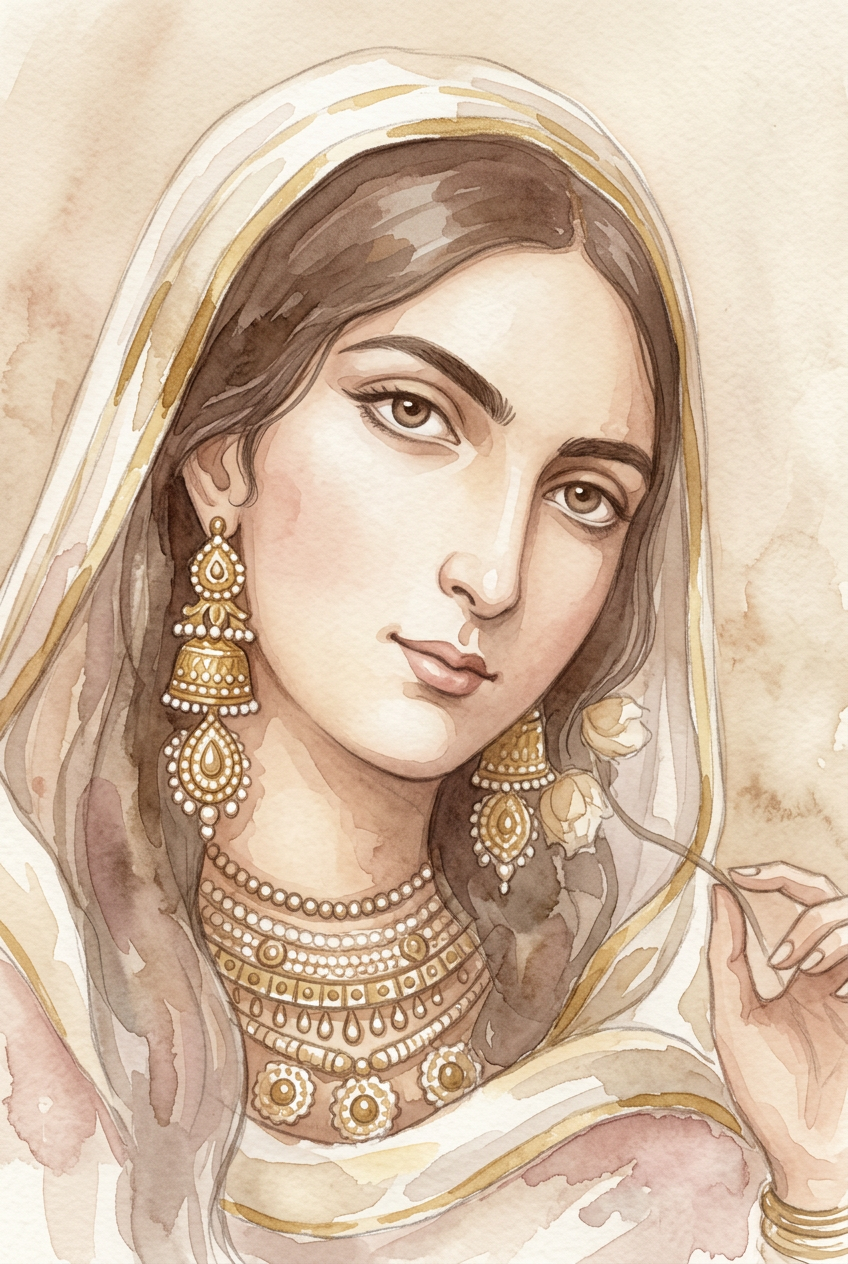
Original illustration for Bharat Legends.
Begum Hazrat Mahal
- ◆Regent of Awadh during the 1857 uprising
- ◆Held Lucknow against British forces for months
- ◆Refused British pension and exile terms
- ◆Died in Kathmandu in 1879, still uncrowned in her homeland
The Story
When the British took away her husband, the Nawab of Awadh, and sent him far away to Calcutta, most people thought the story was over. But Begum Hazrat Mahal had other plans.
In 1857, when soldiers and villagers rose up against British rule, she crowned her young son as the new Nawab and led the revolt from Lucknow herself. She rode with her army, made plans with sepoys and farmers, and held Lucknow against British troops for months.
Begum Hazrat Mahal, born Muhammadi Khanum, was a junior wife of Nawab Wajid Ali Shah of Awadh. After the British annexed Awadh in 1856 and exiled the Nawab, she stayed behind in Lucknow.
When the great uprising of 1857 began, she declared her eleven-year-old son Birjis Qadr the new Nawab and effectively ruled as regent.
She worked closely with rebel leaders like Nana Sahib and Maulvi Ahmadullah Shah, coordinating a joint Hindu–Muslim resistance. She personally attended war councils, issued proclamations rejecting the British 'Queen's Proclamation' of 1858, and defended Lucknow through a long British siege.
When Lucknow finally fell, she refused all British offers of pension and safe conduct, retreated with her forces into the Terai, and eventually took refuge in Kathmandu, Nepal, where she died in 1879. India Post issued a stamp in her honour in 1984.
Learn More
These links go to other websites — ask a grown-up before tapping.
- ›The Last Mughal — William Dalrymple
- ›Awadh in Revolt 1857–1858 — Rudrangshu Mukherjee