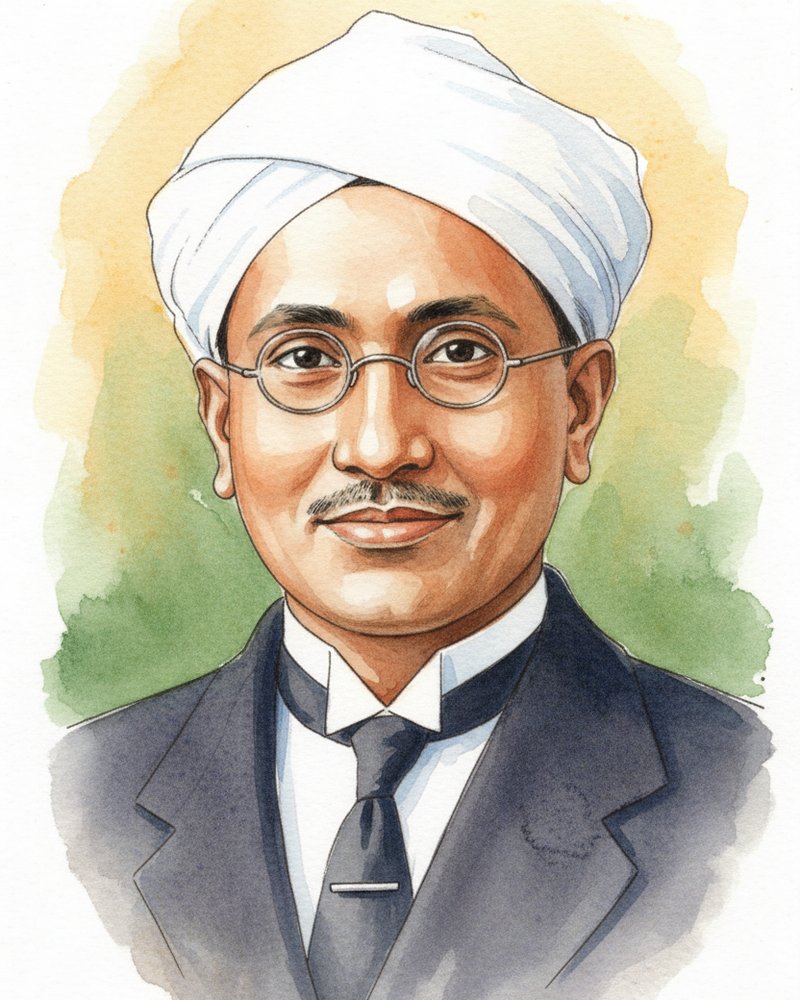
Original illustration for Bharat Legends.
C. V. Raman
- ◆Nobel Prize in Physics, 1930
- ◆Discovered the Raman Effect (1928)
- ◆First Asian to win a science Nobel
- ◆28 February is National Science Day
The Story
On a long sea voyage from London back to India, young Chandrasekhara Venkata Raman kept staring at the ocean and wondering — why is the sea so blue? Back home in Kolkata he set up simple experiments with beams of sunlight and clear liquids, working late into the night.
He discovered a brand-new way that light behaves when it passes through water or gas. That discovery, called the Raman Effect, won him the Nobel Prize in Physics in 1930 — the first science Nobel ever given to an Indian.
C. V.
Raman was born in 1888 in Tiruchirapalli, Tamil Nadu, and moved to Kolkata as a young officer of the Indian Finance Service. He spent his evenings doing physics experiments at the Indian Association for the Cultivation of Science, and later became a full-time professor at Calcutta University.
In 1928, along with his student K. S.
Krishnan, he discovered that when light passes through a transparent material, a small part of it changes colour slightly. This is called the Raman Effect, and it gave scientists a powerful new tool to study the tiny structure of molecules.
It won him the 1930 Nobel Prize in Physics, making him the first Asian to receive a science Nobel. He later founded the Indian Academy of Sciences and the Raman Research Institute in Bengaluru, and encouraged Indian students to do original research.
India celebrates the day of his discovery, 28 February, as National Science Day.
Learn More
These links go to other websites — ask a grown-up before tapping.