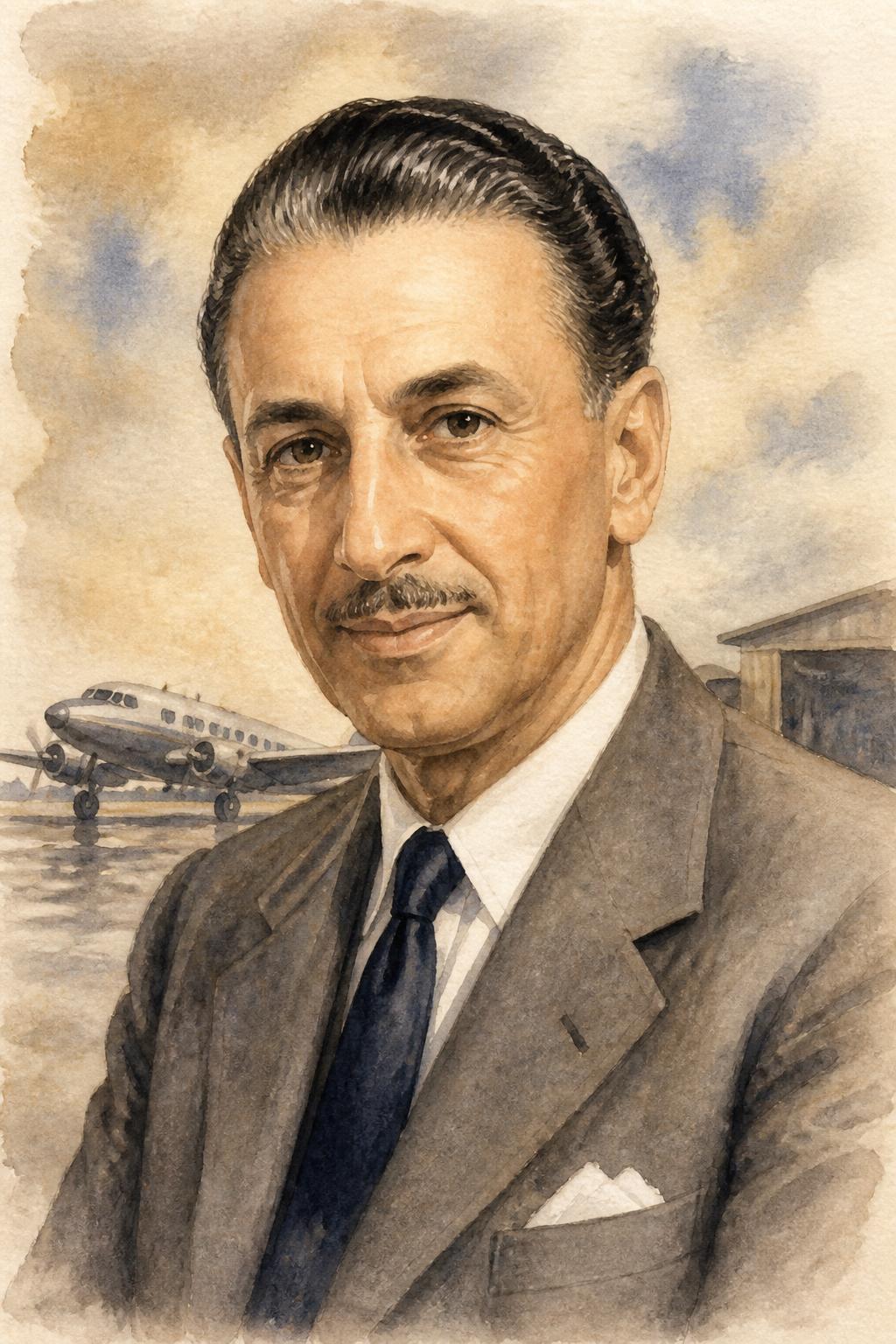
Original illustration for Bharat Legends.
J. R. D. Tata
- ◆India's first licensed pilot (1929) and founder of Air India
- ◆Chairman of Tata Sons for 52 years (1938–1991)
- ◆Founded TIFR, Tata Memorial Hospital and NCPA
- ◆Bharat Ratna, 1992
The Story
JRD loved aeroplanes so much that in 1929 he became the first Indian to earn a pilot's licence. Three years later he flew a tiny De Havilland Puss Moth from Karachi to Bombay carrying the mail — India's very first commercial flight.
That flight became Tata Air Services, then Air India. He also ran the Tata Group for 52 years and grew it from 14 companies to over 90, always insisting that businesses should also care for their workers and their country.
Jehangir Ratanji Dadabhoy Tata (1904–1993) was born in Paris to Ratanji Dadabhoy Tata and Sooni Briere. He earned India's first pilot licence in 1929 and, in October 1932, flew the mail from Karachi to Bombay in a Puss Moth — the birth of Indian civil aviation and of Tata Air Services (later Air India).
He became chairman of Tata Sons in 1938 at the age of 34 and served for 52 years. Under him, Tata launched Tata Chemicals, TELCO (now Tata Motors), Tata Consultancy Services, Titan and Voltas, and reshaped Tata Steel's welfare policies (eight-hour day, provident fund, maternity benefits).
He founded the Tata Institute of Fundamental Research, the Tata Memorial Hospital and the National Centre for the Performing Arts. He was awarded the Bharat Ratna in 1992.
Learn More
These links go to other websites — ask a grown-up before tapping.
- ›Beyond the Last Blue Mountain: A Life of J. R. D. Tata — R. M. Lala
- ›J. R. D. Tata — Britannica