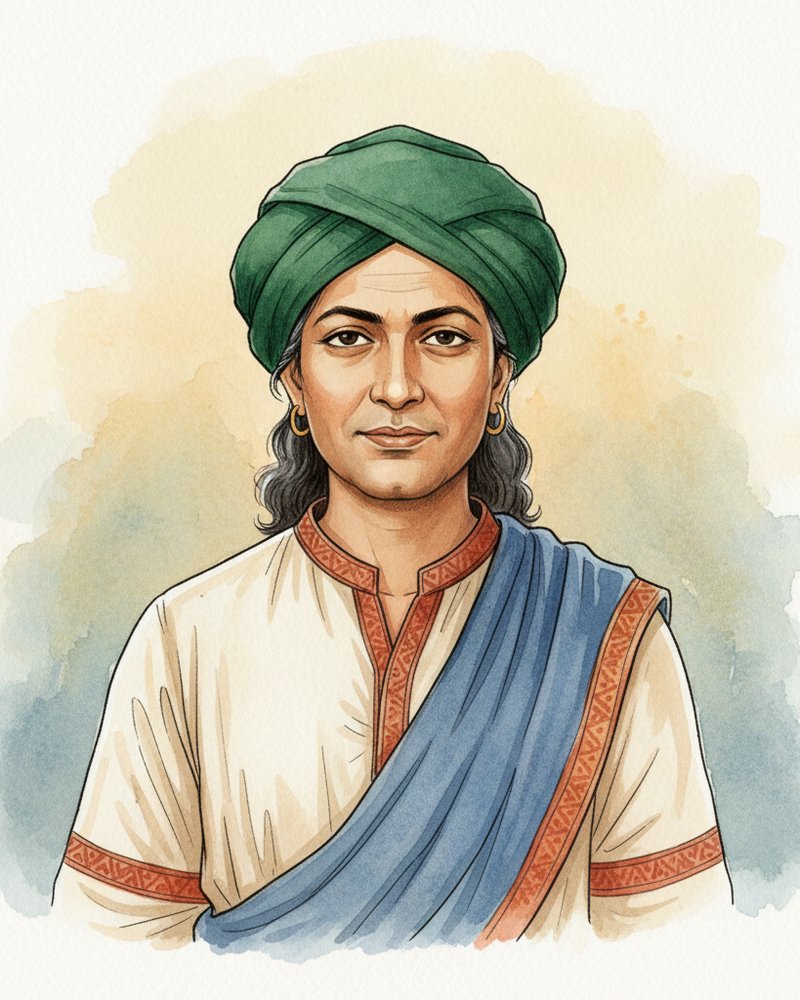
Artistic interpretation — no historical likeness of this figure exists. Original illustration for Bharat Legends.
Kabir
- ◆Verses included in the Guru Granth Sahib
- ◆Founding voice of the Nirguna Bhakti tradition
- ◆Rejected caste and organised ritual
The Story
Kabir was a weaver in Varanasi who worked at his loom by day and sang short, sharp songs by evening. His songs were only a few lines long — called dohas — but each one was like a tiny bright bell.
He laughed at people who fought about which religion was better, and pointed to one gentle God found not in temples or mosques but inside the heart. Hundreds of years later, farmers, sadhus and singers still sing his words.
Kabir was a fifteenth-century poet-saint who lived in and around Varanasi, likely from about 1440 to 1518. Little is known for certain about his life, but he is believed to have been raised in a Muslim weaver family and to have studied with the Hindu Bhakti teacher Ramananda.
His verses draw freely on both Hindu and Sufi ideas.
He wrote in a local everyday language mixed with Braj, Awadhi and Bhojpuri, using short couplets called dohas and longer songs. His poetry, gathered in works like the Bijak, rejects caste hierarchy, empty rituals and blind following of scriptures.
He points instead to a formless divine that can be experienced within. His verses appear in the Sikh holy book, the Guru Granth Sahib, and are still sung by followers of the Kabir Panth, the Dadu Panth and many other traditions.
Kabir remains one of the most influential poet-saints of the Indian Bhakti movement.
Learn More
These links go to other websites — ask a grown-up before tapping.