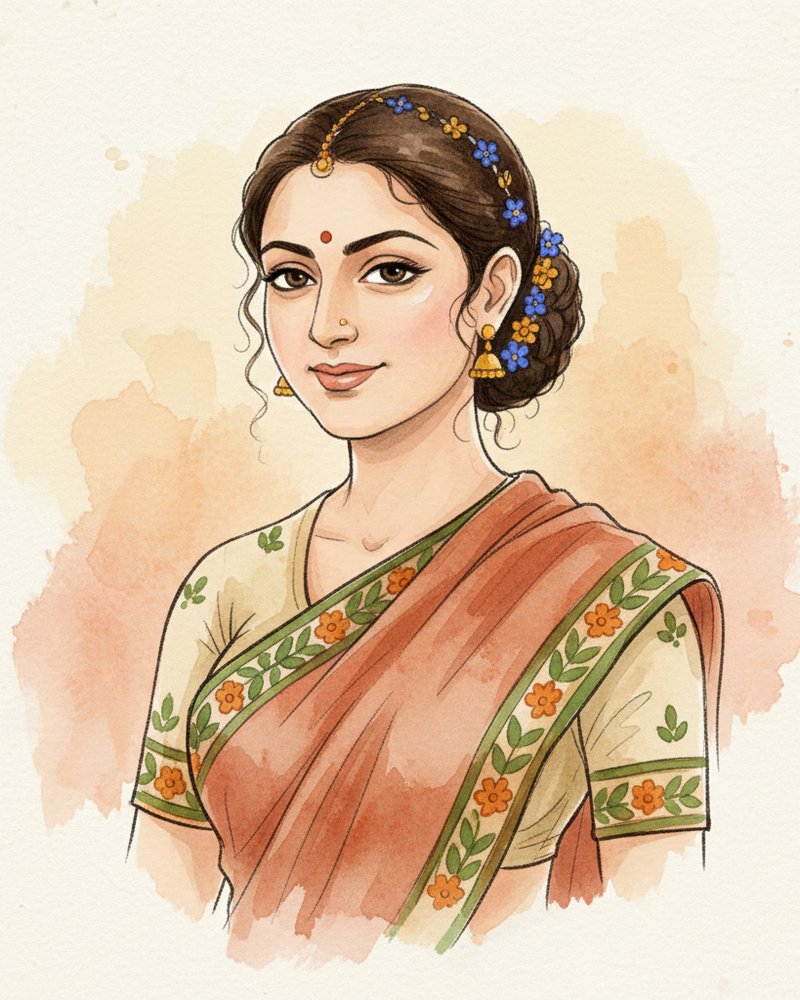
Artistic interpretation — no historical likeness of this figure exists. Original illustration for Bharat Legends.
Meerabai
- ◆Bhakti movement poet-saint
- ◆Composed hundreds of Krishna bhajans
- ◆Defied royal expectations to sing publicly
The Story
Meerabai was a princess in Rajasthan, but her heart belonged to Krishna, the blue-skinned god of her childhood dreams. From the time she was small, she sang songs to Krishna, danced with a small statue of him in her arms, and thought of him as her closest friend.
When she grew up and married into a royal family, they told her that a princess must not sing and dance in public. But Meera would not stop.
She left the palace, wandered from temple to temple, and gave the world some of the most beautiful bhakti songs ever sung.
Meerabai lived around 1498 to 1547 and was a Rajput princess of the Mewar royal family. She was a leading voice of the Bhakti movement, which taught that love and devotion mattered more than caste, ritual or status.
She wrote hundreds of bhajans in the Braj Bhasha language, addressed to Krishna as her divine beloved.
Her family was uncomfortable with her open devotion and unusual life. Stories say they tried more than once to harm her, but she survived and eventually left the palace to live as a wandering singer.
She spent long periods in Vrindavan, closely linked to Krishna's childhood tales, and later in Dwarka. Songs like 'Payoji maine Ram ratan dhan payo' are still sung across India today.
Meerabai's life is remembered as an example of quiet courage and pure devotion.
Learn More
These links go to other websites — ask a grown-up before tapping.