Founding of the Mauryan Empire
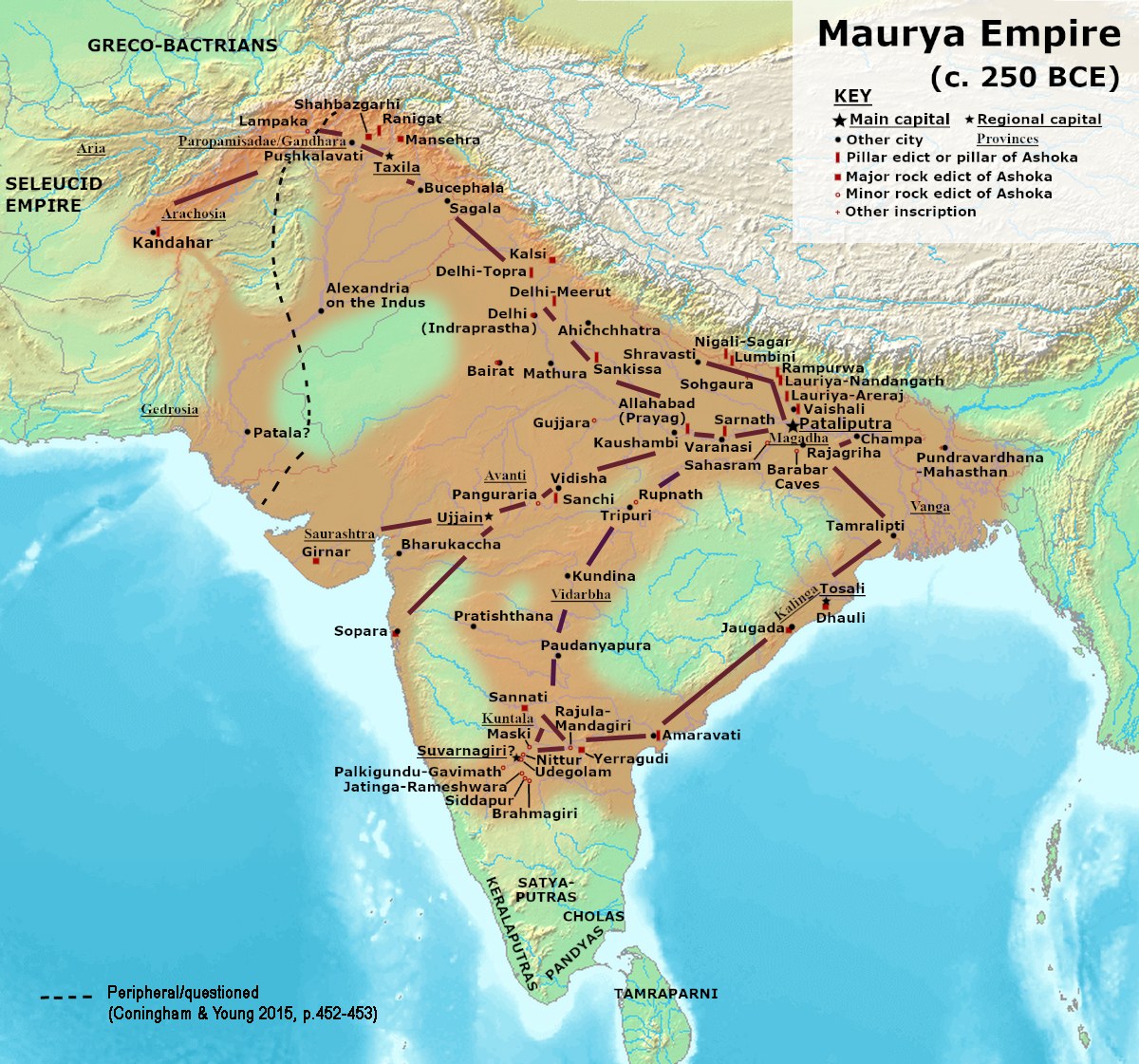
Symbolic image — a map or later illustration, not a photograph of the event. Image via Wikimedia Commons — Maurya Empire map.
The Story
Long ago, most of India was made up of small kingdoms that were always fighting each other. Then a young prince named Chandragupta, with the help of his clever teacher Chanakya, defeated the powerful Nanda kings around 322 BCE.
From their grand capital Pataliputra, on the banks of the Ganga in what is today Bihar, they slowly joined together most of the land we now call India. They built strong roads, sent messengers on horseback, trained a big army, and made rules to help farmers, traders and travellers live peacefully.
This was the beginning of the Maurya Empire — the first great empire of India.
The Maurya Empire, which lasted from about 322 to 185 BCE, was the first empire to join together most of the Indian subcontinent under a single ruler. Chandragupta Maurya, guided by Chanakya's ideas in the Arthashastra, set up a strong central government in the capital city of Pataliputra, near modern Patna.
The Mauryan state ran a professional bureaucracy, a large standing army and a network of informers who kept the emperor updated. Megasthenes, a Greek ambassador sent by Seleucus I to Pataliputra, wrote a book called 'Indica' in which he described the city as bigger and grander than any city in the Hellenistic world, with wooden walls, moats and hundreds of towers.
The empire built long trunk roads, standardised weights and coins, and encouraged trade with the Greek kingdoms in the west and with Southeast Asia. Under Chandragupta's grandson Ashoka, the empire would reach its greatest size and its most famous ideas.
Learn More
These links go to other websites — ask a grown-up before tapping.