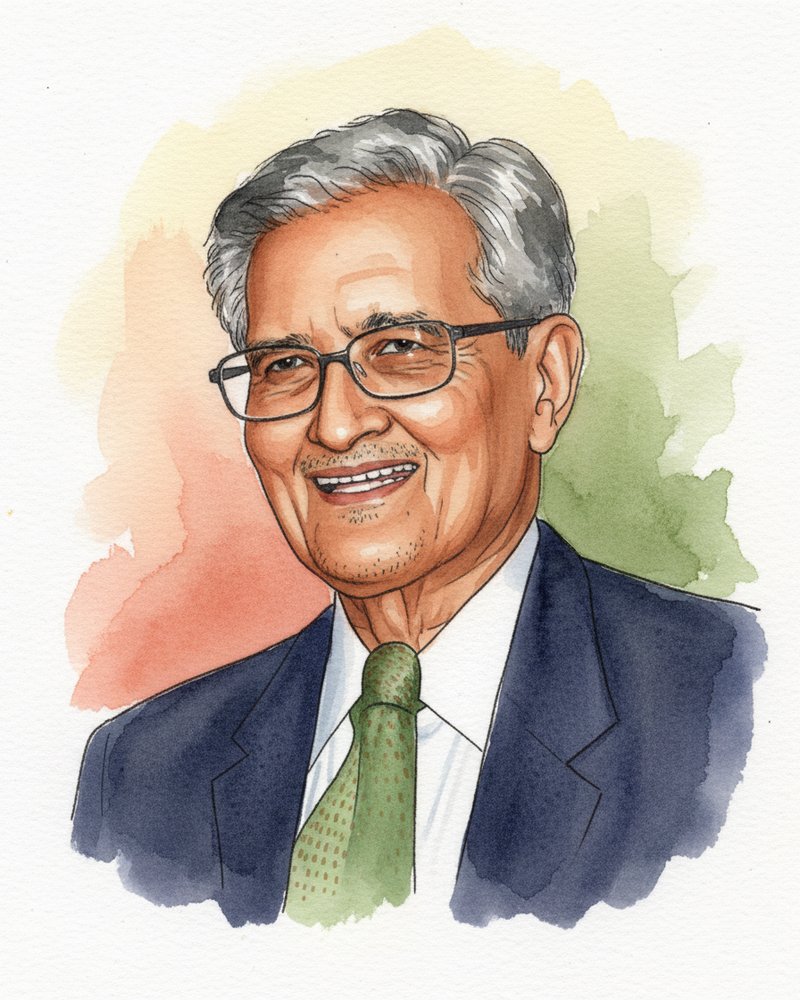
Original illustration for Bharat Legends.
Amartya Sen
- ◆Nobel Prize in Economics, 1998
- ◆Developed the capabilities approach
- ◆Bharat Ratna, 1999
The Story
When Amartya Sen was a young boy in Bengal, he saw people around him going hungry during a terrible famine in 1943. That memory never left him.
He grew up asking a very important question: why do people go hungry even when there is enough food nearby? By carefully studying the answers, he won the Nobel Prize in Economics in 1998, and helped countries around the world understand what real development means.
Amartya Sen was born in 1933 in Santiniketan, West Bengal, and studied at Presidency College, Kolkata, and then at Trinity College, Cambridge. He has taught at Delhi School of Economics, Oxford, Harvard and Cambridge.
In 1998 he received the Nobel Memorial Prize in Economic Sciences for his work in welfare economics, social choice theory, and understanding the causes of famines.
His famous study of the Bengal famine of 1943 showed that hunger was caused not by a lack of food but by the poor being unable to buy it. He developed the 'capabilities approach', which measures how well a society allows people to actually do and be what they want, rather than just how much money they have.
This idea shaped the United Nations Human Development Index, used to compare countries around the world. He was awarded the Bharat Ratna in 1999 and remains one of the most respected voices in global economics and public thought.
Learn More
These links go to other websites — ask a grown-up before tapping.