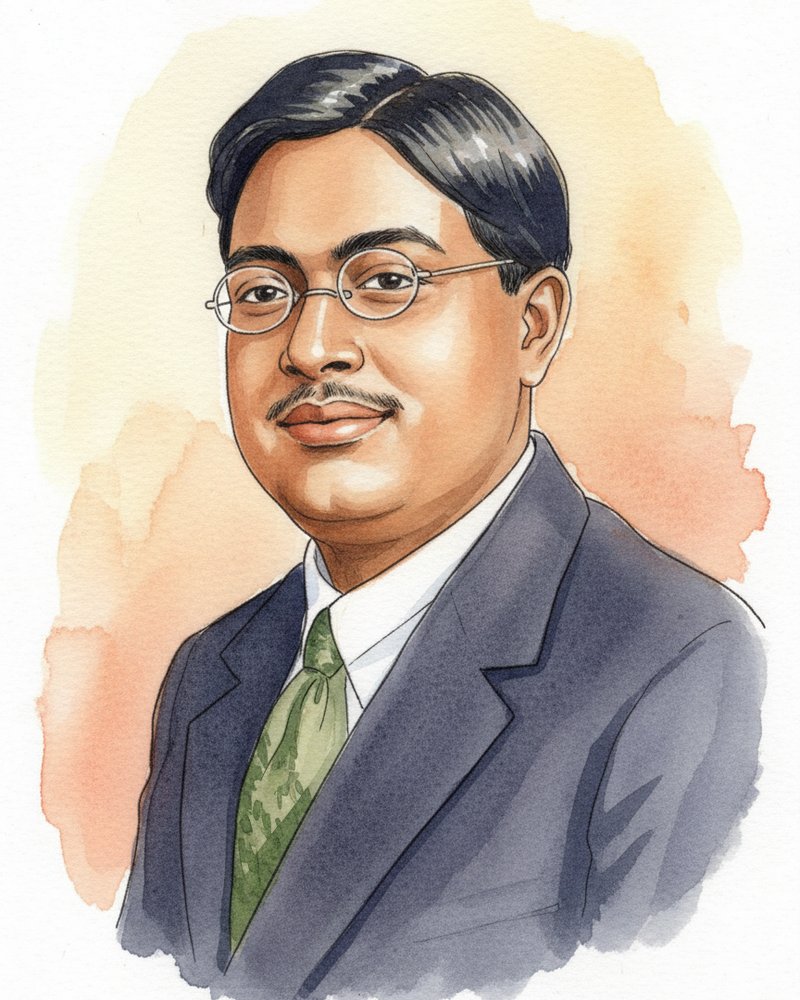
Original illustration for Bharat Legends.
Satyendra Nath Bose
- ◆Co-founder of Bose–Einstein statistics
- ◆Bosons are named after him
- ◆Padma Vibhushan, 1954
The Story
Satyendra Nath Bose was a shy, brilliant professor teaching in Dhaka. He wrote a short paper explaining a new way to think about tiny particles of light.
He sent it to Albert Einstein in Germany. Einstein was so impressed that he translated it himself and helped publish it.
Together their ideas gave us a whole new area of physics. Today, one big family of tiny particles — from photons of light to Higgs bosons — is named 'bosons' after this quiet Indian teacher.
Satyendra Nath Bose was born in 1894 in Calcutta and studied at Presidency College. In 1924, while teaching at the University of Dhaka, he wrote a short paper on how particles of light (photons) share energy statistically, using a method quite different from the classical one.
Journals in England were not sure about it, so he mailed it directly to Einstein.
Einstein translated the paper into German, published it, and extended the ideas to other particles. This became Bose–Einstein statistics, and particles that follow these rules are today called 'bosons' in his honour.
His work laid the foundation for research on Bose–Einstein condensates, a special state of matter created in laboratories decades later. He served as a professor at Dhaka and Kolkata, was awarded the Padma Vibhushan in 1954 and named a National Professor in 1958.
He remained a modest teacher throughout his life.
Learn More
These links go to other websites — ask a grown-up before tapping.