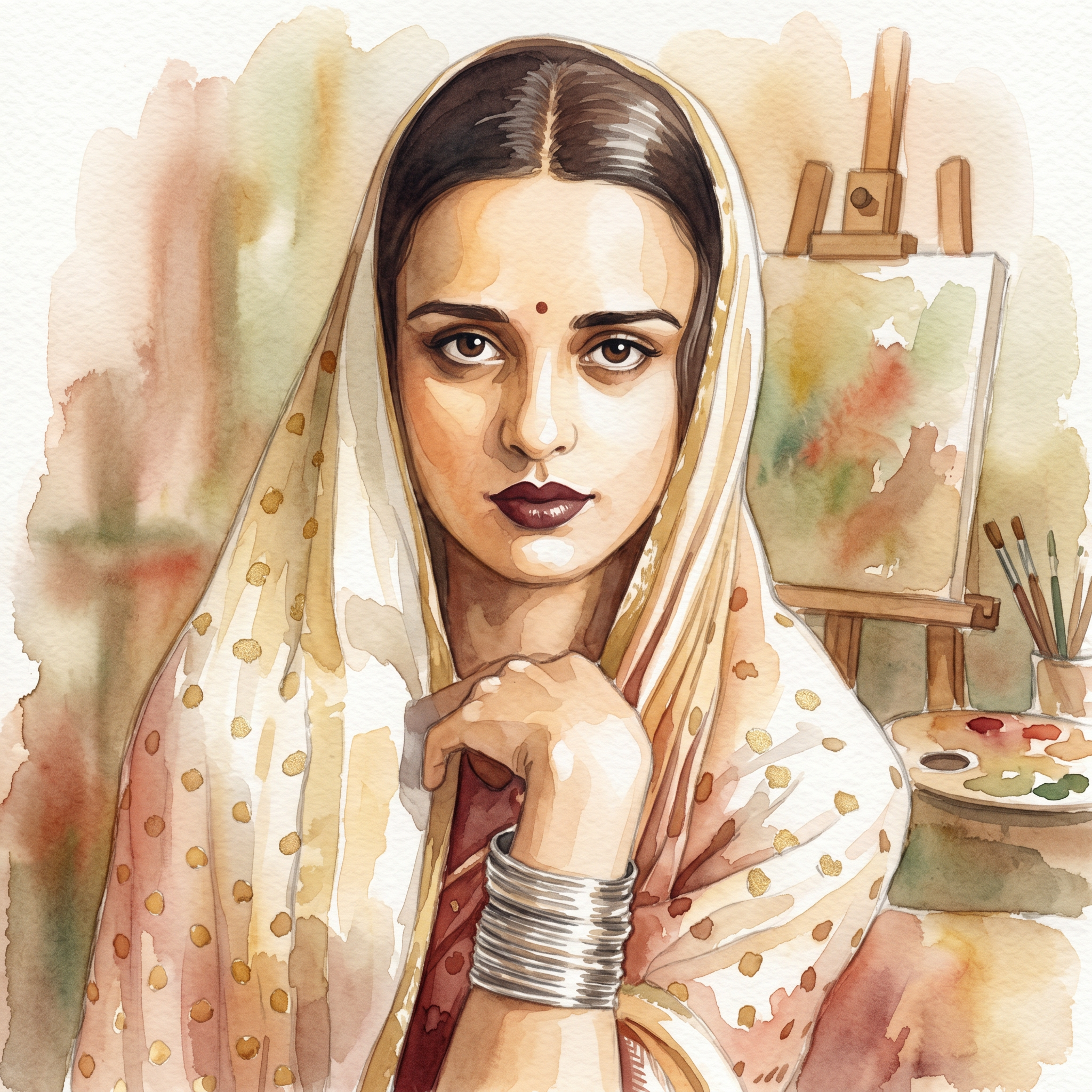
Original illustration for Bharat Legends.
Amrita Sher-Gil
- ◆Called 'mother of modern Indian art'
- ◆Trained at the École des Beaux-Arts, Paris
- ◆Fused European Post-Impressionism with Ajanta and miniature traditions
- ◆Her works are National Art Treasures of India
The Story
Amrita was born in faraway Budapest to an Indian Sikh father and a Hungarian mother. As a young girl she filled sketchbooks with drawings of everyone she met.
She studied art in Paris, but when she came back to India she fell in love with the villages of Punjab and the south. She started painting Indian women, farmers and brides in glowing colours no one had used quite that way before.
Even though she died at only 28, her paintings changed how India saw itself in art.
Amrita Sher-Gil (1913–1941) is often called the mother of modern Indian art. Born in Budapest to Umrao Singh Sher-Gil Majithia, a Sikh aristocrat and scholar, and Marie Antoinette Gottesmann, a Hungarian opera singer, she trained at the École des Beaux-Arts in Paris in the early 1930s.
Her early European work already showed astonishing command of oil paint; her self-portraits from those years are considered masterpieces.
Returning to India in 1934, she consciously turned away from European academic subjects and set out to paint the daily life of Indian villagers, particularly women — 'Three Girls' (1935), 'Bride's Toilet' (1937), 'Brahmacharis' (1937), 'Woman Resting on Charpoy'. She fused Post-Impressionist colour with the flatness of Ajanta murals and Mughal miniatures, creating a new visual language for modern India.
She died mysteriously in Lahore in 1941, aged just 28. The Government of India has declared her works National Art Treasures and they cannot be exported.
Learn More
These links go to other websites — ask a grown-up before tapping.
- ›Amrita Sher-Gil: A Life — Yashodhara Dalmia
- ›Amrita Sher-Gil: An Indian Artist Family of the 20th Century — Schirmer/Mosel