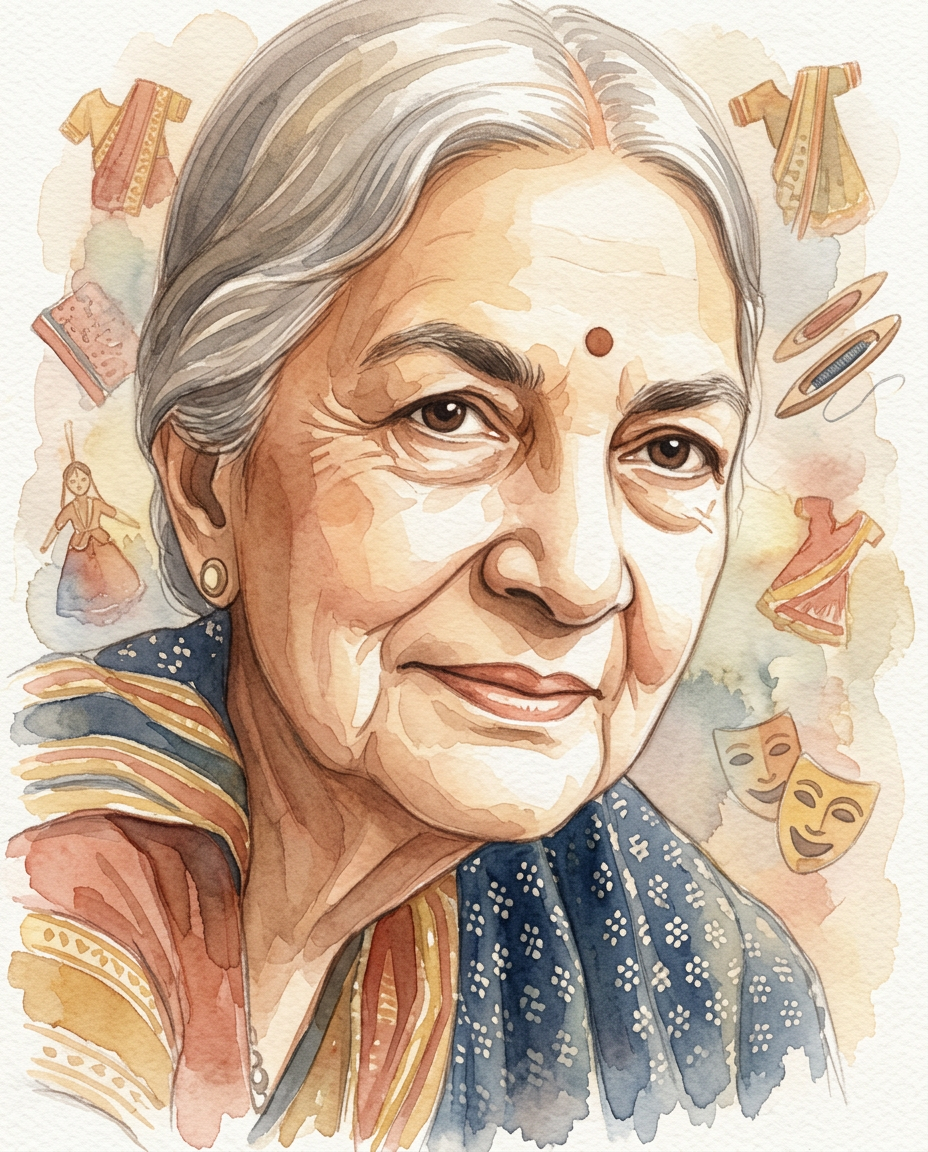
Original illustration for Bharat Legends.
Kamaladevi Chattopadhyay
- ◆First Indian woman to stand for a legislative seat (1926)
- ◆Led women's participation in the 1930 Salt Satyagraha
- ◆Founded India's cooperative handicrafts and theatre institutions
- ◆Padma Vibhushan and Ramon Magsaysay Award winner
The Story
Kamaladevi grew up in a house full of books and famous freedom fighters. She joined Gandhi's Salt March, was arrested many times, and was the first Indian woman to stand for an elected office.
After Independence, she noticed that India's weavers, potters and puppet-makers were losing their work to factory goods. So she opened cooperatives, craft museums and theatre schools to keep those old skills alive.
Every sari, block-printed cloth or hand-woven basket you love today owes something to her.
Kamaladevi Chattopadhyay (1903–1988) was born into a progressive Saraswat family in Mangaluru and married the poet-freedom fighter Harindranath Chattopadhyay, brother of Sarojini Naidu. A committed Gandhian and socialist, she took part in the Salt Satyagraha of 1930 and, along with Avabai Thakersey, insisted that women be allowed to break the salt law alongside men.
In 1926 she became the first Indian woman to run for a legislative seat.
After Independence she chaired the All India Handicrafts Board and the Central Cottage Industries Emporium. She set up the Crafts Council of India, the National School of Drama, Sangeet Natak Akademi and the India International Centre in Delhi.
She almost single-handedly rebuilt the ecosystem for Indian handlooms, khadi, theatre and folk arts at a time when many felt they should be replaced by industry. She was awarded the Padma Bhushan (1955), the Ramon Magsaysay Award (1966) and the Padma Vibhushan (1987).
Learn More
These links go to other websites — ask a grown-up before tapping.
- ›Inner Recesses, Outer Spaces: Memoirs — Kamaladevi Chattopadhyay
- ›Kamaladevi Chattopadhyay: The Romantic Rebel — Reena Nanda