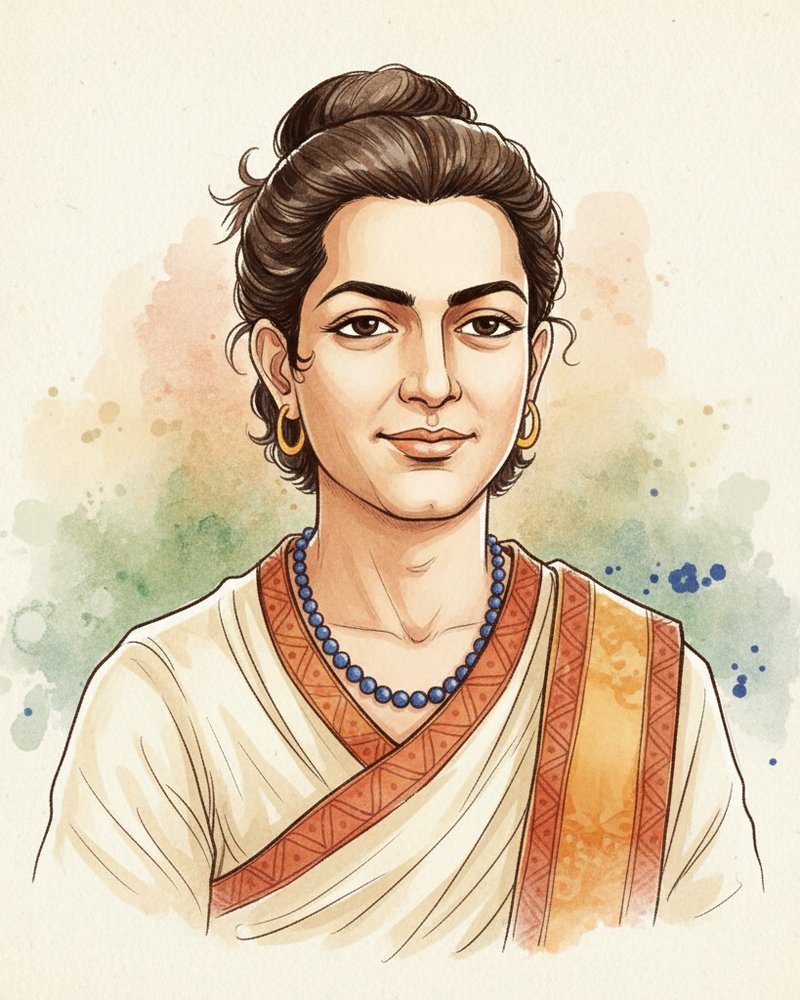
Artistic interpretation — no historical likeness of this figure exists. Original illustration for Bharat Legends.
Aryabhata
- ◆Aryabhatiya composed 499 CE
- ◆Proposed Earth's rotation
- ◆Approximated π to 3.1416
- ◆India's first satellite bears his name
The Story
When Aryabhata was only twenty-three years old, he wrote a book that changed the way people looked at the sky. In it he explained how to use the number zero, how to find the value of pi, and — most amazing of all — that the Earth spins around like a top.
Long before telescopes were invented, this young scholar in Kusumapura, near modern Patna, was already thinking about eclipses and stars. Many centuries later, when India built its very first satellite and sent it into space, the country named it Aryabhata to say thank you.
Aryabhata lived from 476 to 550 CE and worked in Kusumapura, an important centre of learning near the Gupta capital of Pataliputra. His book, the Aryabhatiya, was written in 499 CE when he was just twenty-three.
In it he described the decimal place-value system, made a very accurate table of sines used in trigonometry, and gave pi as about 3.1416 — close to the value we still use.
Aryabhata also proposed that the Earth rotates on its axis, which is why we see the sun rise and set — a bold idea for his time. He explained eclipses using shadows, not myths.
His ideas travelled through Arabic translations to the Islamic world and later reached Europe, shaping the story of mathematics everywhere. In 1975, India named its first satellite after him, so his name now truly orbits the Earth.
Learn More
These links go to other websites — ask a grown-up before tapping.