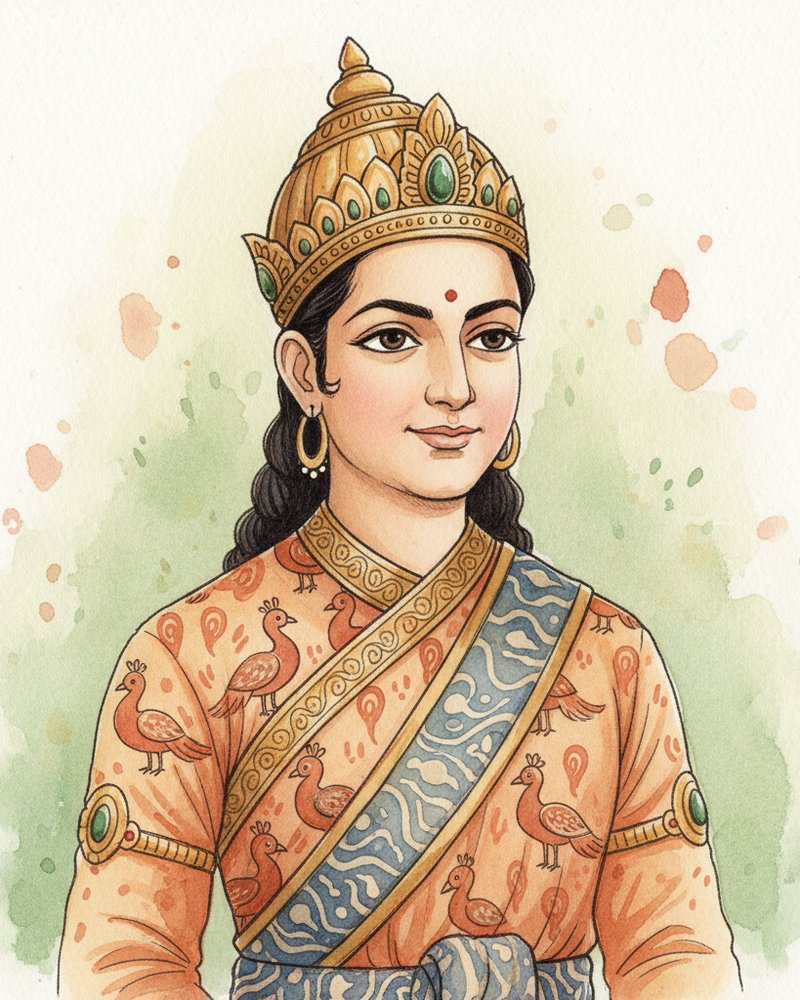
Artistic interpretation — no historical likeness of this figure exists. Original illustration for Bharat Legends.
Chandragupta II Vikramaditya
- ◆Ruled c. 375–415 CE
- ◆Court of the Navaratnas (nine gems)
- ◆Faxian visited India during his reign
- ◆Extended Gupta rule to western India
The Story
Chandragupta II was called Vikramaditya, which means 'Sun of Bravery'. In his time, India felt like a garden in full bloom.
Poets wrote plays about clouds and lovers, mathematicians drew new signs for numbers, and artists carved beautiful caves and temples. Nine wise scholars, called the Navaratnas or 'nine gems', gathered at his court.
One of them was the famous poet Kalidasa, whose stories are still read today. Travellers came from far-away China and wrote that India was peaceful, kind and full of learning.
Chandragupta II reigned from about 375 to 415 CE and was the third great emperor of the Gupta dynasty. He extended Gupta power all the way to the western sea by defeating the Kshatrapa rulers of Gujarat, opening up new trade with the world.
His capital cities of Pataliputra and Ujjain became meeting points for poets, astronomers, doctors and artists.
His reign is often called a golden age of Indian culture. Kalidasa wrote his best plays and poems here.
Astronomers built on ideas that would soon appear in Aryabhata's work. A Chinese Buddhist traveller named Faxian visited India during his time and described a happy, well-run country where people were treated gently.
The famous Iron Pillar of Delhi, which has stood for more than 1,600 years without rusting, was raised in his honour and still amazes scientists today.
Learn More
These links go to other websites — ask a grown-up before tapping.