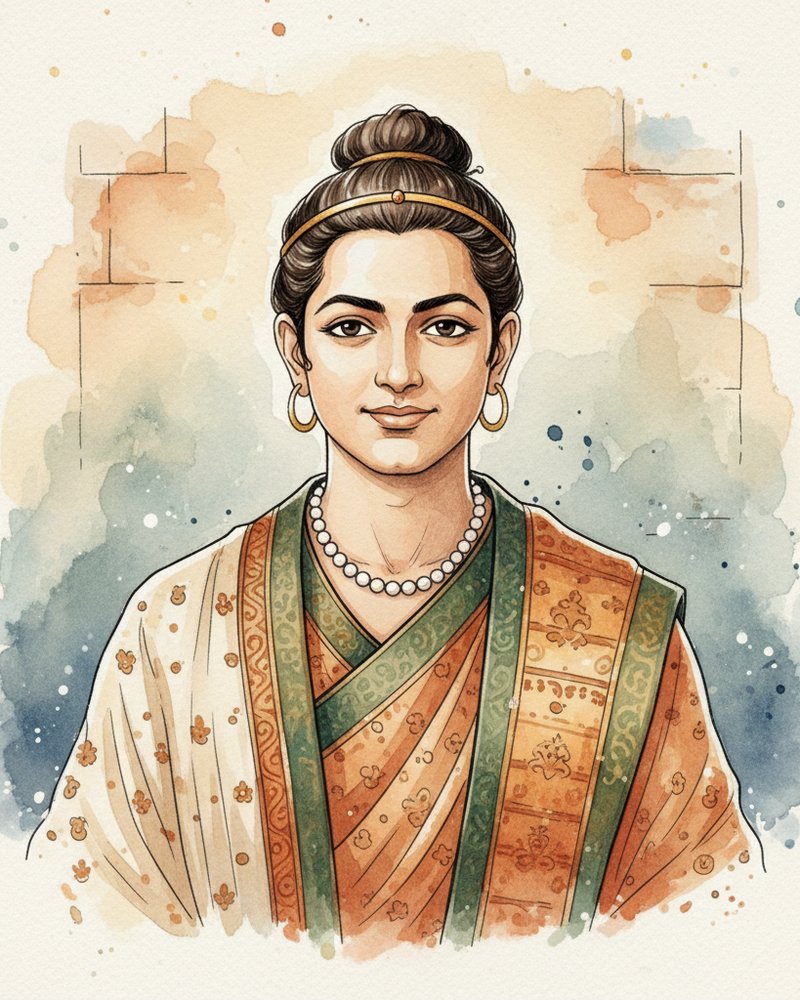
Artistic interpretation — no historical likeness of this figure exists. Original illustration for Bharat Legends.
Ashoka the Great
- ◆Ruled c. 268–232 BCE
- ◆Kalinga War convert to non-violence
- ◆Sent Buddhist missions as far as Sri Lanka and Greece
- ◆Sarnath lion capital = India's national emblem
The Story
Ashoka was born a prince and grew up to be a mighty emperor. At first he fought many wars to make his kingdom bigger.
But after one terrible war in a land called Kalinga, he walked across the battlefield and saw fields full of tears and pain. His heart broke.
From that day, Ashoka put down his sword and picked up the teachings of the Buddha instead. He asked his people to be kind to animals, to tell the truth, and to help each other.
He carved these gentle rules onto tall stone pillars all over his empire, so anyone passing by could read them. The lions on top of one of his pillars are still the national symbol of India today.
Ashoka Maurya ruled from about 268 to 232 BCE and was the grandson of Chandragupta Maurya. Early in his reign he expanded the empire by force, and around 261 BCE he conquered the kingdom of Kalinga, in modern Odisha.
The number of people killed and left homeless shocked him so deeply that he wrote about it in his own words on rock edicts we can still read today.
After Kalinga, Ashoka became a Buddhist and started a public way of life he called Dhamma — kindness, honesty, tolerance and care for animals, poor people and travellers. He planted shade trees along roads, built rest houses and wells, and sent Buddhist teachers as far as Sri Lanka, Egypt and Greece.
His edicts, carved in local languages like Prakrit and even Greek, are among the earliest Indian writings we can still read. The four-lion capital from his pillar at Sarnath is now India's national emblem.
Learn More
These links go to other websites — ask a grown-up before tapping.
- ›Ashoka: The Search for India's Lost Emperor — Charles Allen
- ›The Edicts of King Ashoka — Ven. S. Dhammika