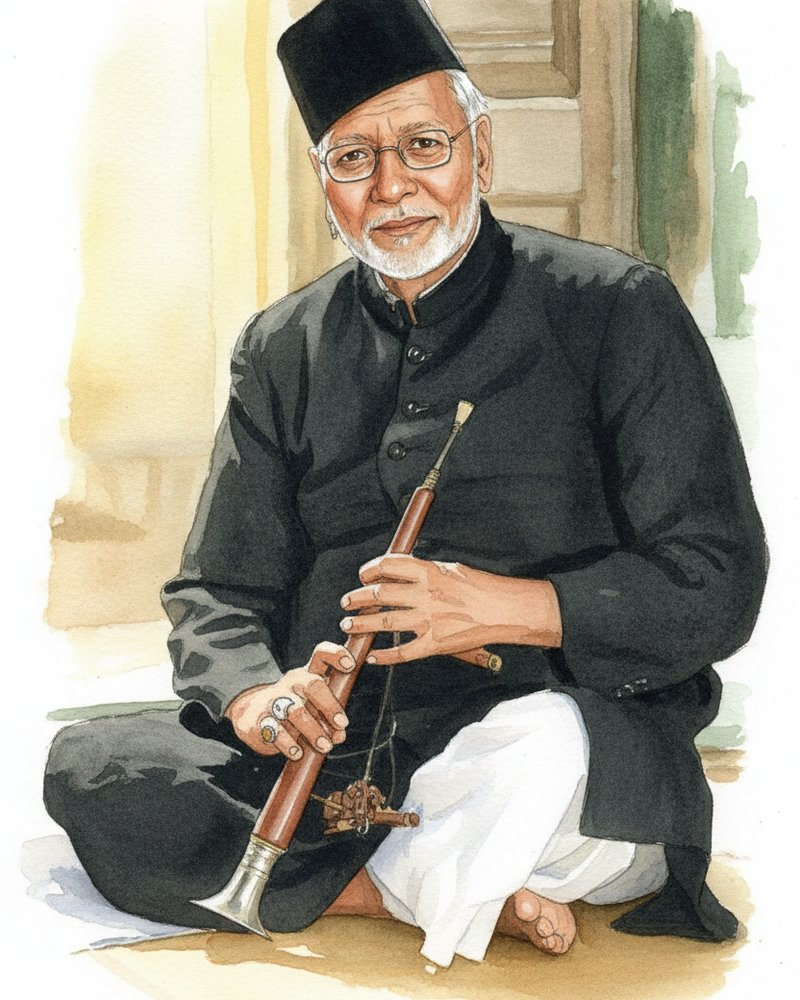
Original illustration for Bharat Legends.
Ustad Bismillah Khan
- ◆Bharat Ratna, 2001
- ◆Played at the Red Fort on Independence Eve, 1947
- ◆Padma Vibhushan, 1980
The Story
Ustad Bismillah Khan loved his shehnai — a slim wooden pipe with a reed that makes a bright, singing sound. Before him, the shehnai was mostly played at weddings.
He made it a great concert instrument, played all over the world. On the eve of Independence in 1947, his shehnai sang from the Red Fort in Delhi, welcoming a free India.
For the rest of his life he played that joyful sound every Independence Day.
Ustad Bismillah Khan was born Qamaruddin Khan in 1916 in Dumraon, Bihar. He trained with his uncle Ali Bux 'Vilayatu' at the Kashi Vishwanath temple in Varanasi, where he later spent most of his life.
He turned the shehnai from a folk and wedding instrument into a serious classical instrument respected across India.
He famously played from the ramparts of the Red Fort on the eve of Independence, 15 August 1947, and performed there again on the eve of every Republic Day for many years. He performed all over the world, including at Edinburgh, Osaka and the World Exposition in Montreal.
Deeply religious, he was a devout Muslim who was also devoted to the Ganga and to Saraswati, the Hindu goddess of learning. He received the Padma Shri, Padma Bhushan, Padma Vibhushan and finally the Bharat Ratna in 2001 — only the third musician ever to receive it.
Learn More
These links go to other websites — ask a grown-up before tapping.