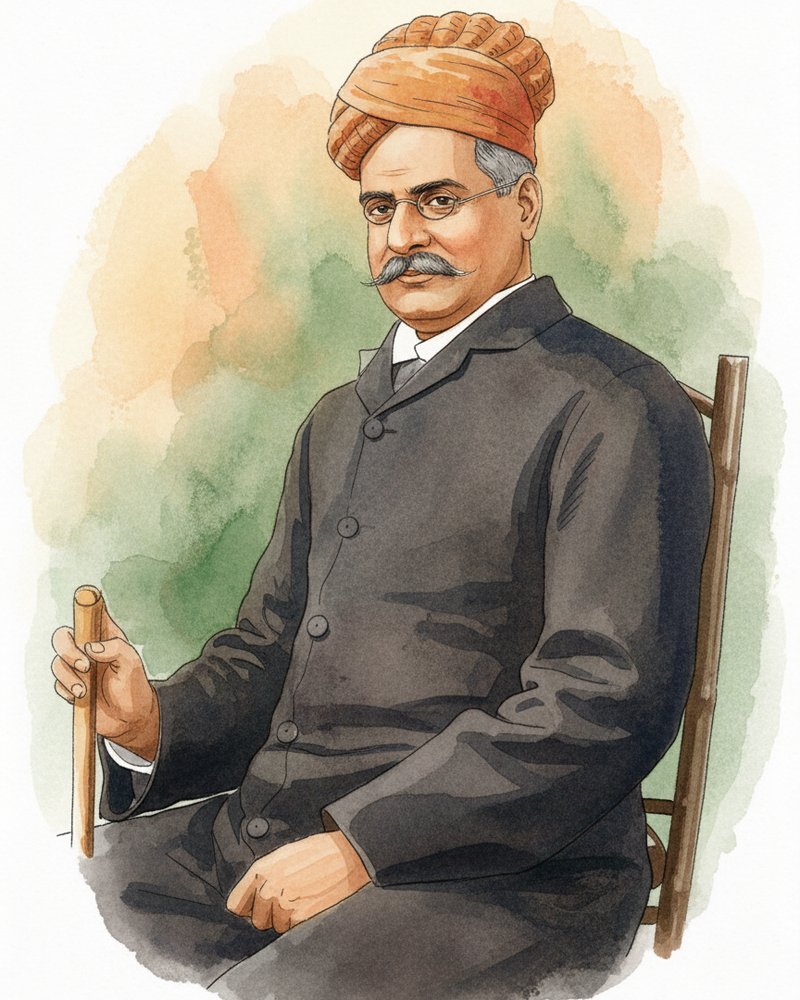
Original illustration for Bharat Legends.
Raja Ravi Varma
- ◆Fused European realism with Indian subjects
- ◆Founded a lithographic press for mass prints
- ◆Kaiser-i-Hind Gold Medal, 1904
The Story
Raja Ravi Varma was a painter from Kerala who painted queens, gods, goddesses and everyday women with soft light and rich colour. He gave the gods of India faces that people all over the country recognised.
Then he did something even more clever — he opened a printing press, so that copies of his paintings could be printed cheaply. Suddenly, families in small towns and villages could hang beautiful pictures of Lakshmi or Saraswati on their walls.
Raja Ravi Varma was born in 1848 into the royal family of Kilimanoor in Kerala. He learnt European oil-painting techniques and combined them with Indian mythological and cultural subjects.
His paintings of scenes from the Ramayana and Mahabharata, and of women in different Indian saris, made him famous across British India.
He set up a lithographic press near Bombay in the 1890s, later moved to Malavli. It printed affordable colour prints called oleographs of his paintings, which reached homes, calendars and shop walls all over India.
His images shaped how many Indians pictured their gods, goddesses and heroes for generations. He received the Kaiser-i-Hind Gold Medal in 1904 from the British government.
Although some scholars argue about how European his style was, he remains a giant of nineteenth-century Indian art.
Learn More
These links go to other websites — ask a grown-up before tapping.