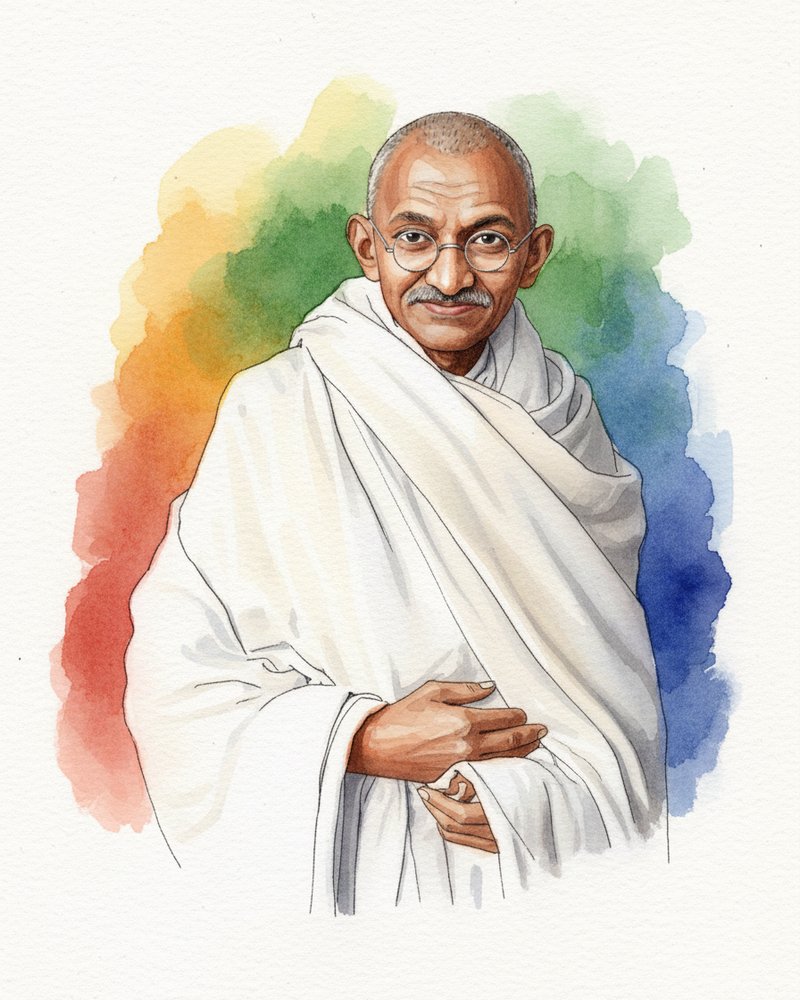
Original illustration for Bharat Legends.
Mahatma Gandhi
- ◆Led the Dandi Salt March, 1930
- ◆Pioneer of non-violent civil resistance
- ◆Assassinated on 30 January 1948
- ◆TIME Person of the Year 1930
The Story
Mahatma Gandhi believed that the greatest strength in the world is being gentle and truthful. He wore a simple piece of white cloth, spun his own thread on a small wooden wheel called a charkha, and taught India to fight for freedom without hitting or hurting anyone.
When the British made a law saying only they could sell salt, Gandhiji walked 240 miles all the way to the sea. On 6 April 1930 he bent down, picked up a fistful of salt from the shore and said, in effect, 'This salt belongs to India.' With that quiet act, he shook a huge empire.
Mohandas Karamchand Gandhi was born on 2 October 1869 in Porbandar, Gujarat. He studied law in London, worked in South Africa, and returned to India in 1915 with a powerful new idea he called satyagraha, or 'truth-force'.
Instead of fighting with weapons, he asked people to refuse unfair rules with courage and patience.
He led three great movements: Non-Cooperation in 1920, Civil Disobedience in 1930 (with the famous Dandi Salt March), and Quit India in 1942. He turned the Indian National Congress into a mass movement that reached villages, women, students and workers.
He also worked all his life to bring Hindus and Muslims together and to end the mistreatment of people once called 'untouchables'. Gandhiji was killed on 30 January 1948, but his ideas inspired heroes like Martin Luther King Jr. and Nelson Mandela around the world.
Learn More
These links go to other websites — ask a grown-up before tapping.