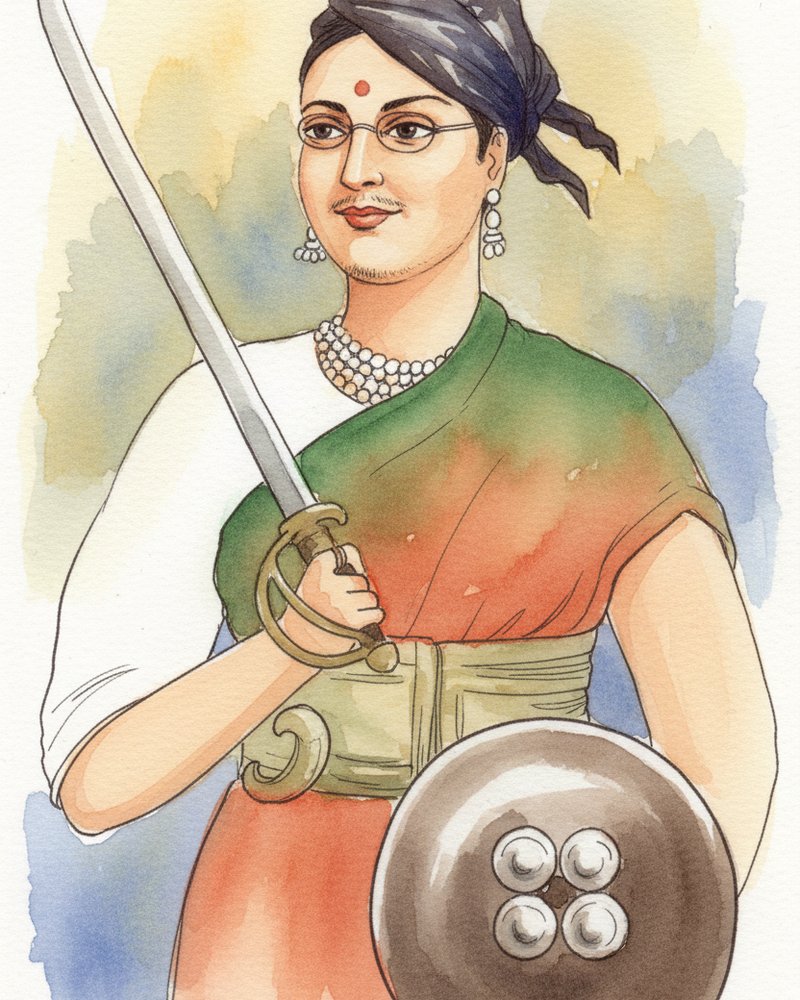
Original illustration for Bharat Legends.
Rani Lakshmibai
- ◆Central figure of the 1857 uprising
- ◆Died in battle at Gwalior, June 1858
- ◆Rejected the British Doctrine of Lapse
- ◆Immortalised in the poem 'Jhansi ki Rani'
The Story
When the British tried to take away her small kingdom of Jhansi after her husband died, Rani Lakshmibai stood up and said no. She tied her little adopted son to her back, put on her armour, took her sword and rode out to fight.
'Main apni Jhansi nahi doongi' she cried — 'I will not give up my Jhansi'. She fought bravely in battle after battle, until she died at just twenty-nine years old, defending the freedom of her people.
Manikarnika Tambe was born in 1828 in Varanasi and married the Maharaja of Jhansi, becoming Rani Lakshmibai. When her husband died, the British East India Company used a rule called the Doctrine of Lapse to try to take over Jhansi, claiming her adopted son could not inherit.
She refused.
When the great uprising of 1857 broke out, she took charge of Jhansi's defence and later joined other rebel leaders like Tantia Tope and Rao Sahib. She fought fiercely at Jhansi, Kalpi and Gwalior.
On 18 June 1858, she was killed in battle near Gwalior at just twenty-nine years old, still in the middle of the fight. Her courage was later captured forever in the famous Hindi poem 'Khoob ladi mardani woh to Jhansi wali rani thi' by Subhadra Kumari Chauhan.
She remains one of India's most loved heroes.
Learn More
These links go to other websites — ask a grown-up before tapping.