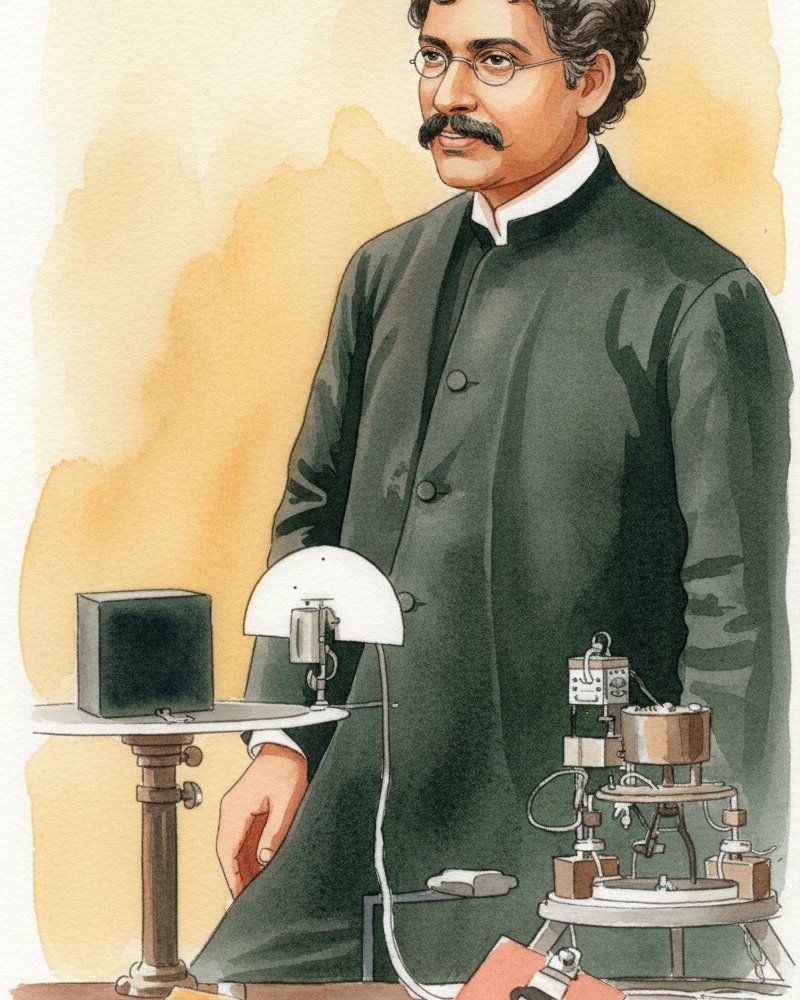
Original illustration for Bharat Legends.
Jagadish Chandra Bose
- ◆Pioneer of radio/microwave communication
- ◆Founded the Bose Institute, 1917
- ◆First Indian scientist elected FRS (1920)
The Story
Jagadish Chandra Bose was a scientist with a curious mind and a gentle heart. Long before phones and Wi-Fi, he sent invisible radio waves across a hall in Kolkata and made a distant bell ring by remote control.
Then he turned his attention to plants and built a special instrument to measure how they respond to touch, heat and even music. He showed the world that plants breathe, feel tired, and get excited too.
Sir Jagadish Chandra Bose was born in 1858 in Bikrampur, in today's Bangladesh. He studied physics at Cambridge and returned to teach at Presidency College in Kolkata, where he was one of the first Indian physicists to gain international recognition.
In 1895, two years before Marconi's famous public demonstration, Bose showed radio (millimetre-wave) transmission in Kolkata, using a device that produced and detected short electromagnetic waves. He also studied how plants respond to different stimuli, and invented an instrument called the crescograph that could magnify plant growth ten thousand times so it could be seen.
He founded the Bose Institute in Kolkata in 1917, one of India's first research institutes. He was knighted the same year and became the first Indian scientist elected a Fellow of the Royal Society in 1920.
He also wrote one of the earliest Bengali science-fiction stories.
Learn More
These links go to other websites — ask a grown-up before tapping.