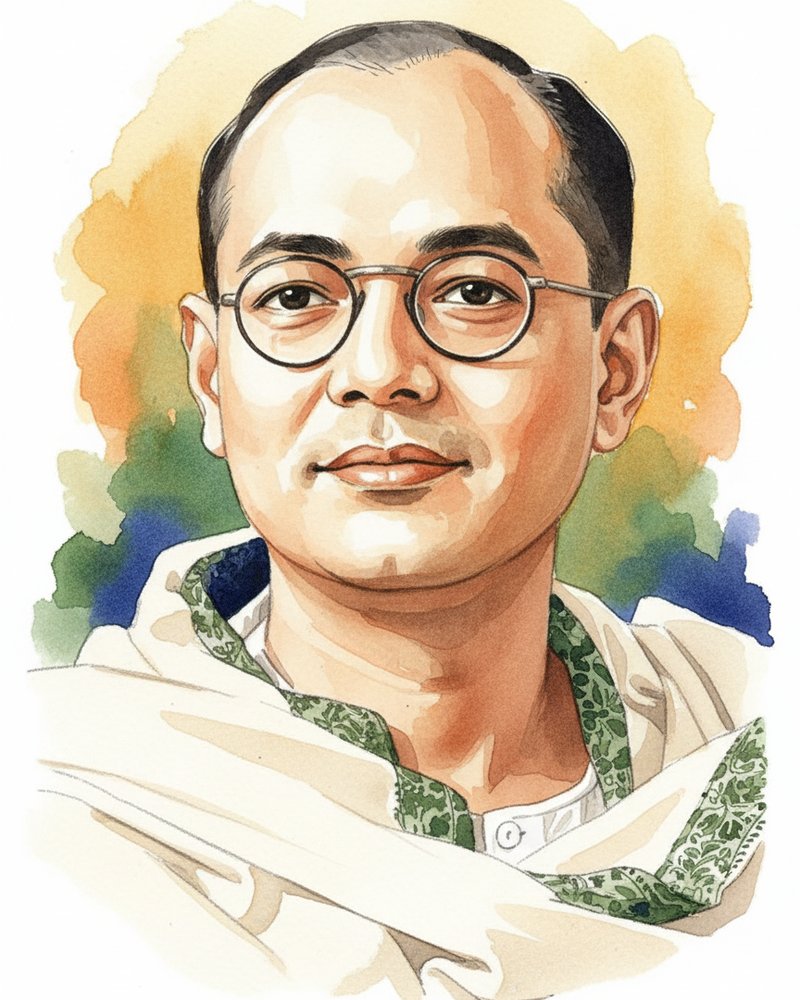
Original illustration for Bharat Legends.
Subhas Chandra Bose
- ◆Founded the Provisional Government of Free India, 1943
- ◆Led the Indian National Army
- ◆Coined 'Jai Hind' as national greeting
- ◆Fate after August 1945 remains disputed
The Story
Netaji Subhas Chandra Bose believed India could not wait for freedom — India had to go out and fight for it. He was placed under house arrest by the British in Kolkata, but one night he slipped out in disguise and travelled across the world, first to Germany and then to Japan.
There he gathered thousands of Indians living abroad and formed the Azad Hind Fauj, the Indian National Army. Standing before his soldiers he said, 'Tum mujhe khoon do, main tumhein azadi doonga' — 'Give me your blood, and I will give you freedom.'
Subhas Chandra Bose was born in 1897 in Cuttack, Odisha. A brilliant student, he passed the very tough Indian Civil Service exam but resigned to join the freedom movement.
He served twice as president of the Indian National Congress, but disagreed with Gandhi's slower, non-violent methods.
In 1941 he escaped house arrest in Calcutta and travelled through Afghanistan and the Soviet Union to Germany. From there he sailed by submarine to Japanese-occupied Southeast Asia.
In Singapore he took charge of the Indian National Army — the Azad Hind Fauj — made up of Indian soldiers and civilians already living in the region. In 1943 he set up a Provisional Government of Free India based in the Andaman and Nicobar Islands.
INA units fought alongside Japan at Imphal and Kohima in 1944. He is officially said to have died in a plane crash near Taipei in August 1945, but many stories about him still remain.
His greeting 'Jai Hind' became a national salute of India.
Learn More
These links go to other websites — ask a grown-up before tapping.