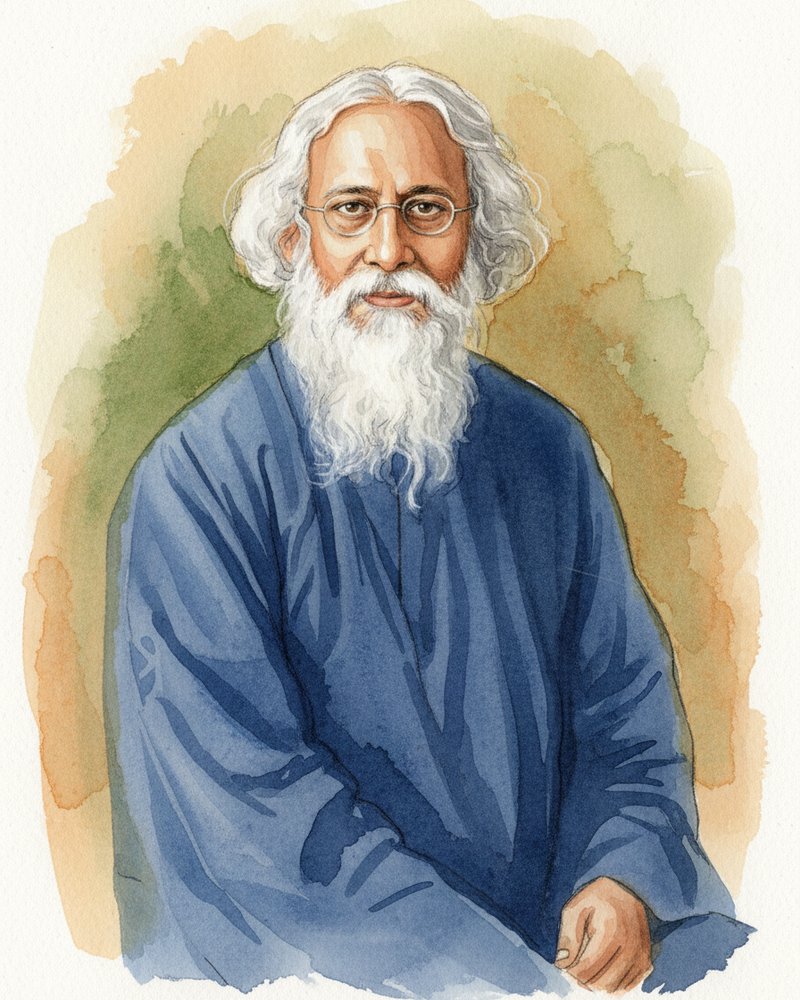
Original illustration for Bharat Legends.
Rabindranath Tagore
- ◆Nobel Prize in Literature, 1913
- ◆Wrote India's national anthem
- ◆Founded Visva-Bharati University
- ◆First non-European Nobel laureate in literature
The Story
Rabindranath Tagore was a poet, painter, teacher and singer all rolled into one gentle person. He grew up in a large family full of writers and musicians in Bengal, and by the time he was a teenager he was already writing poems.
He wrote songs so beautiful that India and Bangladesh both chose them as their national anthems. He also started a very special school under the trees at Shantiniketan, where children could learn while listening to the wind.
In 1913 he became the first Indian to win the Nobel Prize in Literature.
Rabindranath Tagore lived from 1861 to 1941 and reshaped Bengali literature, music and art. He wrote poems, short stories, novels, plays and over 2,000 songs known as Rabindra Sangeet, which are still sung across Bengal.
His poetry collection Gitanjali, which he translated into English himself, won him the 1913 Nobel Prize in Literature — the first Nobel for anyone in Asia.
Tagore also composed the national anthems of two countries: 'Jana Gana Mana' for India and 'Amar Sonar Bangla' for Bangladesh. In 1901 he started an experimental school in Shantiniketan that grew into Visva-Bharati University, a place where art, nature and learning went hand in hand.
When the Jallianwala Bagh massacre took place in 1919, he returned his knighthood in protest. He began painting seriously in his sixties and left behind hundreds of unique artworks.
Above all, he believed education and imagination could set human beings free.
Learn More
These links go to other websites — ask a grown-up before tapping.