Founding of Nalanda University
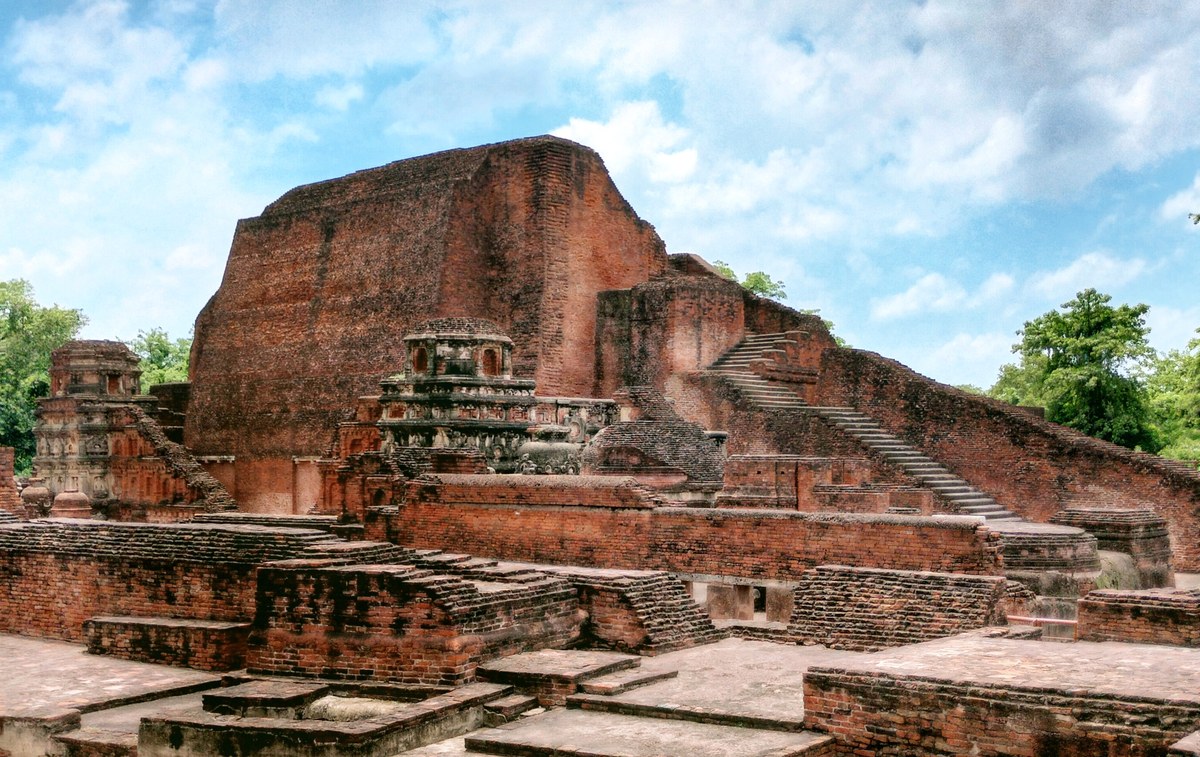
The Story
In a quiet green corner of Bihar, more than 1,500 years ago, monks and scholars built a school so huge that students came all the way from China, Korea, Tibet and Sri Lanka to study there. It was called Nalanda.
Nalanda had a nine-storey library called Ratnodadhi, which means 'Ocean of Jewels', full of thousands of hand-copied books on palm leaves. Ten thousand students walked its halls, learning about mathematics, medicine, astronomy, grammar and Buddhist philosophy.
It is often called the world's first residential university.
Nalanda Mahavihara, founded around 427 CE, thrived under the support of the Gupta kings and later the Pala dynasty for about eight hundred years. It was located near modern Rajgir in Bihar and became one of the most famous centres of learning in the ancient world.
At its peak Nalanda had thousands of students and teachers living together on a vast campus of stupas, prayer halls, classrooms and student quarters. Its curriculum included Buddhist philosophy of many schools, logic, medicine, grammar, astronomy and mathematics.
The Chinese Buddhist monk Xuanzang studied there for years in the seventh century and later wrote detailed accounts of Nalanda's teachers, discipline and libraries. The nine-storey library, Ratnodadhi, is said to have held hundreds of thousands of manuscripts.
The university was destroyed around 1200 CE during the invasion of Bakhtiyar Khilji, and its libraries burned for many days. A modern university has now been built nearby, trying to revive its spirit.
Learn More
These links go to other websites — ask a grown-up before tapping.